> For the complete documentation index, see [llms.txt](https://docs.chat.ngo/llms.txt). Markdown versions of documentation pages are available by appending `.md` to page URLs; this page is available as [Markdown](https://docs.chat.ngo/workspaces/workspace-settings.md).

# Workspace Settings

<figure><img src="/files/cncuorjl8xV4D0oqJJWu" alt=""><figcaption></figcaption></figure>

The **Workspace Settings** section allows [admins and managers](/workspaces/workspace-settings/roles-and-permissions.md) to configure key elements of their workspace, ensuring it is tailored to meet the needs of the organization. From managing members to configuring AI models, this section provides all the tools necessary for maintaining and optimizing a workspace.

### How to Access Workspace Settings

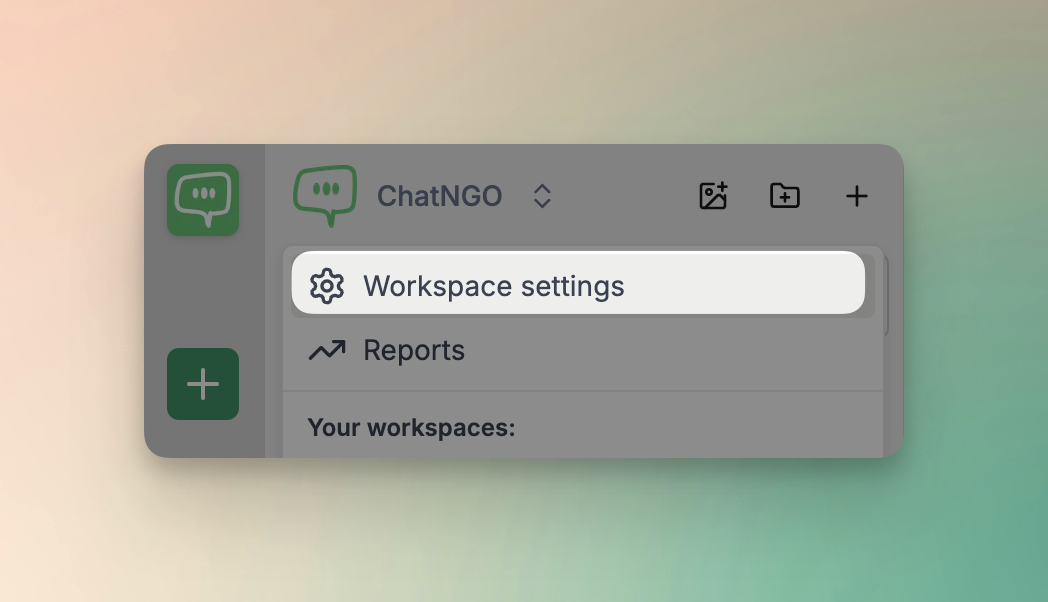
1. From your workspace, click on **Your Workspace Name** on the top menu.
2. Select **Workspace Settings** from the dropdown options.

#### Key Sections of Workspace Settings

<table data-view="cards"><thead><tr><th></th><th></th></tr></thead><tbody><tr><td><strong>General</strong></td><td>Configure basic settings for your workspace, such as the name, workspace URL, and workspace icon. These elements help identify and customize your workspace.</td></tr><tr><td><strong>Members</strong></td><td>Manage who has access to the workspace, assign roles (Admin, Manager, User), and invite new members. This section ensures that the right people have the appropriate permissions within the workspace.</td></tr><tr><td><strong>Models &#x26; Credentials</strong></td><td>Set up and manage the AI models available to your team. You can add API keys for different AI models (such as OpenAI, Anthropic, Perplexity), and enable or disable models based on your team’s needs.</td></tr><tr><td><strong>Custom Instructions</strong></td><td>Create and manage custom instructions that can be applied to AI prompts. These instructions help fine-tune the behaviour of AI models, allowing them to respond in line with your organization's specific tone, style, or guidelines.</td></tr></tbody></table>


---

# Agent Instructions
This documentation is published with GitBook. GitBook is the documentation platform designed so that both humans and AI agents can read, navigate, and reason over technical content effectively. Learn more at gitbook.com.

## Querying This Documentation
If you need additional information that is not directly available in this page, you can query the documentation dynamically by asking a question.

Perform an HTTP GET request on the current page URL with the `ask` query parameter, and the optional `goal` query parameter:

```
GET https://docs.chat.ngo/workspaces/workspace-settings.md?ask=<question>&goal=<endgoal>
```

`ask` is the immediate question: it should be specific, self-contained, and written in natural language.
`goal` is optional and describes the broader end goal you are ultimately trying to accomplish on behalf of the user. GitBook uses it to tailor the answer towards what is most useful for that goal.

The response will contain a direct answer to the question and relevant excerpts and sources from the documentation.

Use this mechanism when the answer is not explicitly present in the current page, you need clarification or additional context, or you want to retrieve related documentation sections.